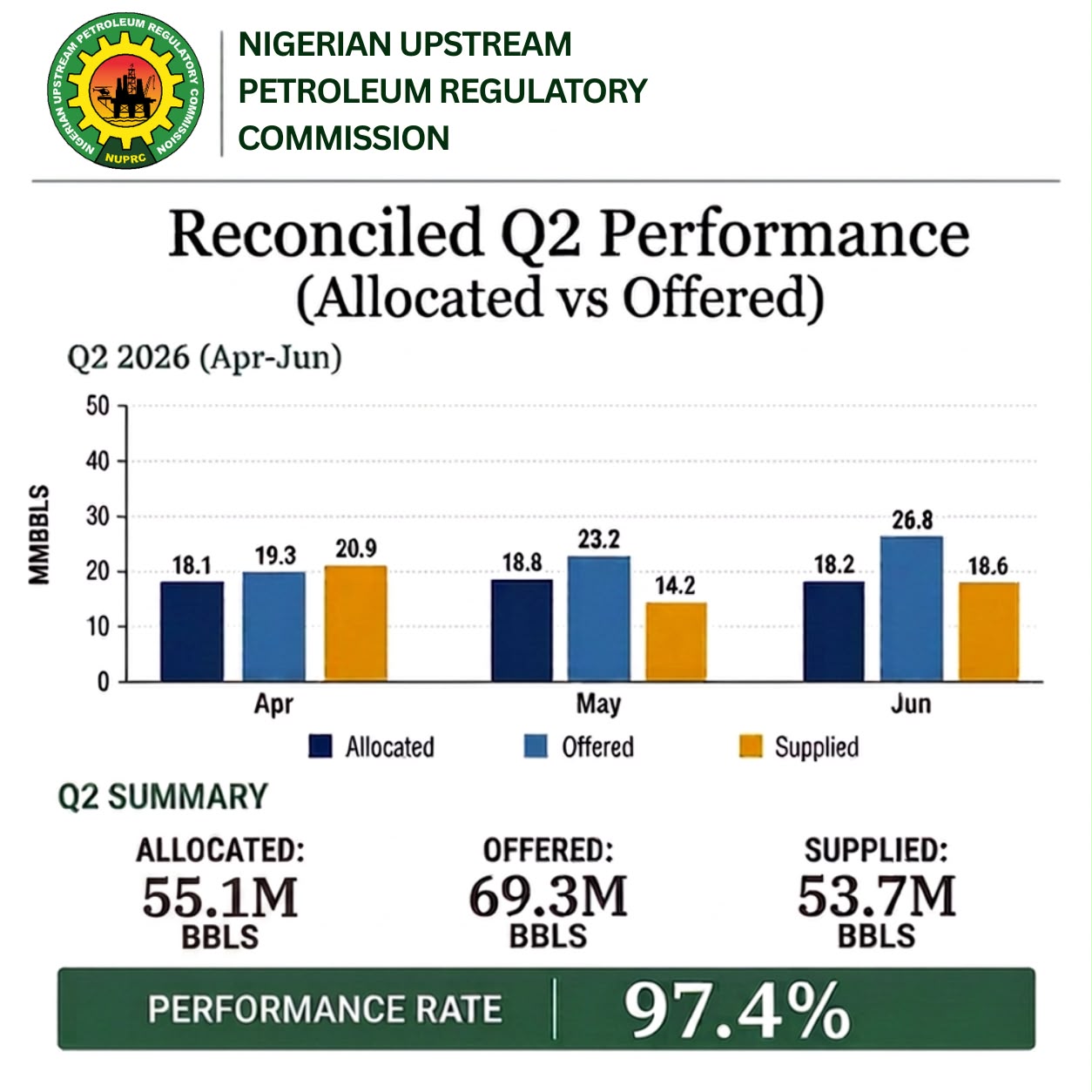

.53.7m barrels supplied against 55.1m barrels allocated in Q2 2026
Nigeria’s upstream sector recorded a 97.4 per cent supply performance rate in the second quarter of 2026, with a total of 53.7 million barrels supplied against 55.1 million barrels allocated, according to data released by the Nigerian Upstream Petroleum Regulatory Commission (NUPRC) on Monday.
The Commission’s reconciled Q2 performance data, covering April to June 2026, showed that volumes offered by producers significantly exceeded the quantities allocated during the period, reaching 69.3 million barrels.
The figures indicate that while producers offered more crude than was formally allocated, actual supplies remained slightly below the aggregate allocation target.The monthly breakdown showed a relatively strong performance in April, when 18.1 million barrels were allocated, while producers offered 19.3 million barrels and supplied 20.9 million barrels.

April was therefore the only month in the quarter in which supplied volumes exceeded both allocated and offered quantities.

ALSO READ:
- NIPCO Targets 3MMTPA FLNG Plant in $3bn Gas Investment Push
- FG Commissions 581kWp Interconnected Mini-Grid to Power Community in Kwara State
- TotalEnergies, AMNI Take FID on $800m Ima Gas Field
- 20 YEARS AFTER: NDPHC Moves to Revive N4bn Ikot Abasi Power Project
- Nominations for ENERGY TIMES’ AWARDS Close Saturday
The performance changed in May, as allocated volumes rose marginally to 18.8 million barrels, while offered volumes surged to 23.2 million barrels. Actual supplies, however, fell to 14.2 million barrels.This represented the weakest monthly supply performance in the quarter and accounted for a significant portion of the gap between allocated and supplied volumes.June sees sharp increase in offersIn June, allocated volumes stood at 18.2 million barrels, while offered volumes climbed further to 26.8 million barrels, the highest monthly offer recorded during the quarter.
Actual supplies recovered to 18.6 million barrels, marginally exceeding the monthly allocation by about 400,000 barrels.The June figures point to a widening gap between volumes producers were prepared to offer and volumes ultimately supplied, with the difference standing at approximately 8.2 million barrels.The Q2 figures provide an important indication of the dynamics between upstream allocations, producer offers and actual physical supply.
Although the aggregate 97.4 per cent performance rate suggests that the sector delivered close to its allocated volumes, the 15.6 million-barrel difference between volumes offered and volumes supplied highlights the extent to which offers did not translate fully into actual deliveries.For the Nigerian oil industry, closing this gap remains critical to improving crude availability, strengthening refinery feedstock supply and boosting government revenues.
The data also show that the supply challenge is not necessarily a question of producers’ willingness to offer crude. With 69.3 million barrels offered compared with 55.1 million barrels allocated, the more pressing issue is ensuring that offered volumes are effectively converted into actual supplies.