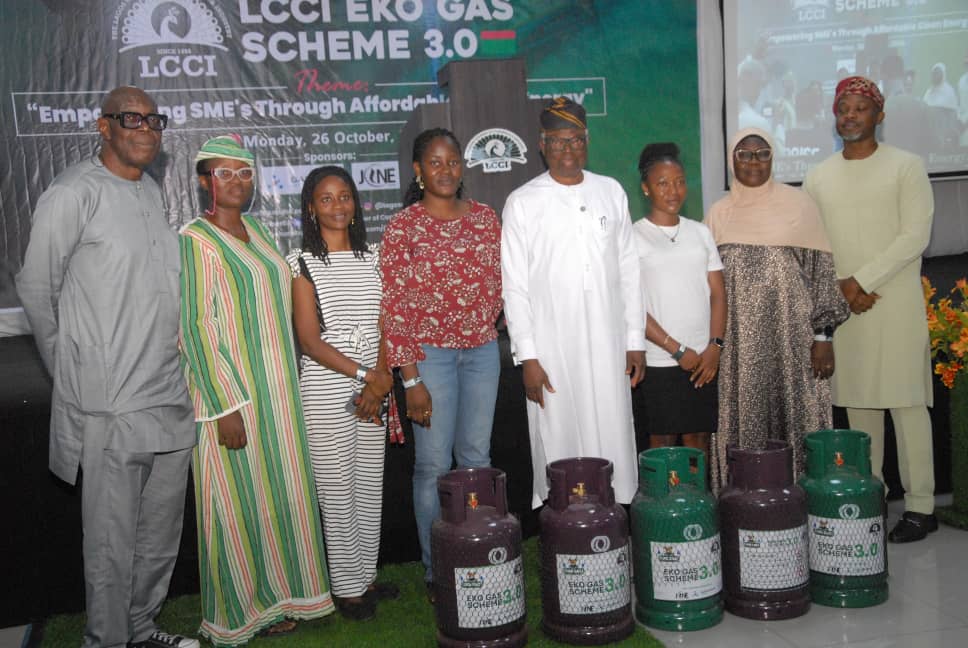
One hundred and fifty roadside food vendors in Lagos have received liquefied petroleum gas (LPG) cylinders and accessories under an initiative by the Lagos Chamber of Commerce and Industry (LCCI), JNewton and Gasavant Africa to reduce cooking costs and limit exposure to harmful smoke.
The distribution was carried out under the LCCI Eko Gas Scheme 3.0, themed: “Empowering SMEs through Affordable Clean Energy.” The programme combines equipment support with practical safety demonstrations to help small businesses adopt LPG safely.
Tackling the Cost Barrier for Small Businesses
The Chairperson of the LCCI LPG and Downstream Natural Gas Sectoral Group, Mrs. Jacqueline Addy, said rising fuel prices were placing considerable pressure on small businesses, including bakeries, caterers, restaurants and roadside food vendors.

She identified the upfront cost of cylinders, burners and accessories as a major barrier to switching from traditional cooking fuels.

Addy explained that providing the necessary equipment alongside safety education would help micro-enterprises overcome this initial hurdle and make informed decisions about their energy needs.
The Vice Chairman of the LCCI LPG and Downstream Natural Gas Sectoral Group and Managing Director of Gasavant Africa, Engr. Chukwuemeka Iheme, said that affordable and reliable energy was essential to the productivity and survival of small enterprises, many of which lacked the capital to invest in alternative systems.
He reaffirmed Gasavant Africa’s commitment to supporting initiatives that expand access to LPG and promote responsible usage through consumer education and collaboration among industry operators, business associations and government institutions.
Economic Benefits and Lessons from Previous Initiatives
The Chief Commercial Officer of Gas Terminalling and Distribution Limited, Mr. Abubakar Folami, highlighted the potential cost savings from switching to cleaner fuels, drawing on his experience in grassroots engagement and community campaigns.
According to Folami, converting petrol- or diesel-powered generators to LPG-powered alternatives could reduce operating costs by 50 per cent to 75 per cent, depending on the equipment, application and prevailing fuel prices.
He cited the example of a local baker who converted her generator during a period of rising fuel prices and subsequently encouraged five neighbouring bakers to follow suit.
Folami also noted that replacing charcoal with gas burners could help roadside food vendors reduce daily expenses while limiting smoke exposure for themselves and surrounding communities.
Reflecting on previous campaigns, including the distribution of 20,000 gas cylinders across 50 Community Development Associations, he identified several lessons for future programmes. These included co-funding arrangements, under which beneficiaries contribute part of the equipment cost and post-distribution monitoring to track usage, collect feedback and assess programme outcomes.
He stressed that practical demonstrations and continuous safety education were important in addressing public concerns about LPG. He also explained the distinct applications of LPG, compressed natural gas (CNG) and liquefied natural gas (LNG) across domestic, commercial, transportation and industrial settings.
Folami further highlighted a proposed LPG Gas 4.0 framework that could extend the initiative to communities across all local government areas in Lagos State, subject to funding availability.
Participants called for government-backed, low-interest financing schemes that would allow small business owners to make affordable initial payments and spread equipment costs over time.
Supply Chains and Infrastructure Remain Key Challenges
An executive member of the LCCI LPG and Downstream Natural Gas Sectoral Group, Ms. Flora Ebhohimen, highlighted the impact of supply chain costs on LPG prices.
Drawing on her experience monitoring freight rates, vessel schedules and bulk gas prices, she explained how these factors influence the final cost to consumers.
She noted that Lagos’s growing population was placing increasing pressure on energy infrastructure, while many households continued to rely on firewood and charcoal and numerous businesses depended on costly diesel generators.
Ebhohimen identified high cylinder acquisition costs, regulatory bottlenecks and distribution gaps as major barriers to wider LPG adoption.
She also linked access to cleaner cooking solutions to the three pillars of sustainable development: environmental protection, economic growth and social progress. Women and children, she noted, could benefit particularly from reduced exposure to smoke associated with traditional cooking fuels. She urged industry stakeholders and LCCI members to invest in gas infrastructure and strengthen consumer education to improve access across Lagos communities.
LCCI Seeks Investment and Affordable Financing
The President and Chairman of the LCCI Council, Mr. Leye Kupoluyi, highlighted the financial strain that rising fuel prices and unreliable electricity supply placed on small and medium-sized enterprises (SMEs), many of which rely on petrol and diesel generators to sustain operations.
He called for increased investment in Nigeria’s gas sector, affordable financing models tailored to small businesses and stronger collaboration among government agencies, financial institutions and private-sector operators.
Kupoluyi also advocated policies that would support gas distribution infrastructure and reduce the financial barriers preventing SMEs from investing in alternative energy solutions.
Safety Education Takes Centre Stage
The event featured a presentation on LPG safety standards and proper handling by Mr. Sola Akano, who stressed the need for strict adherence to safety procedures, particularly in densely populated urban communities.
He warned that leaking gas exposed to an ignition source could cause a fire or explosion. He urged users to purchase standardised regulators, hoses and connectors and avoid substandard accessories that could increase the risk of leakage.
Akano also advised that cylinders should be kept upright in well-ventilated areas, away from enclosed spaces, direct heat, open flames and other potential ignition sources. Proper installation and routine inspection, he said, were essential to preventing accidents.
The LCCI Eko Gas Scheme 3.0 seeks to help grassroots entrepreneurs overcome the initial cost of LPG equipment while promoting safe handling and use. Its long-term impact will depend on sustained adoption, effective monitoring, accessible financing and continued investment in distribution infrastructure.