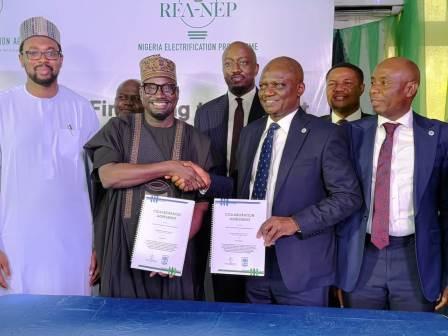
Nigeria’s drive toward universal electricity access has received a major boost as the Rural Electrification Agency (REA) signed a landmark Memorandum of Understanding (MoU) with Lotus Bank, unlocking a N100 billion renewable energy access financing facility.
The collaboration establishes a structured financing support strategy aimed at bridging Nigeria’s energy access gap and accelerating electricity delivery to unserved and underserved rural communities nationwide.
The agreement, sealed on Monday, formalizes a partnership to provide bespoke project financing to mini-grid developers participating in the Distributed Access to Renewable Energy (DARES) programme.
DARES, a World Bank-supported scale-up of the Nigeria Electrification Project (NEP), is implemented by the REA to expand private sector-led electricity access to households, public institutions, and commercial customers across the country.
Under the terms of the MoU, Lotus Bank will make available a revolving credit facility of N100 billion to enable developers procure essential equipment for renewable energy projects. The facility provides up to N8 billion per developer with a tenure of up to 18 months.

In addition, the bank will offer up to 90 percent counterpart funding for projects approved under result-based financing (RBF) programmes, subject to credit risk assessment. This is expected to significantly ease liquidity constraints that have historically slowed renewable energy deployment in rural communities.

Speaking at the signing ceremony, the Managing Director/CEO of the REA, Abba Abubakar Aliyu, described the partnership as a milestone in Nigeria’s electrification agenda.
“This partnership with Lotus Bank is a significant milestone in our commitment to promoting universal access to affordable and sustainable electricity. By securing this N100 billion credit facility, we are directly addressing the debt financing bottleneck that has historically hindered project developers. This ensures that reliable electricity can be delivered more efficiently to the rural communities that need it most, in line with our National Electrification Strategy.”
ALSO READ:
- Sterling Oil Bags Excellence Award at NAEC Conference for Second Consecutive Year
- NNPC Extends Petrol Discount to October 31, Says No Return to Subsidy
- REA, Stanbic IBTC Bank Seal ₦100bn deal to Support Renewable Energy Projects
- KEDCO Deepens Community Impact with Women Empowerment Initiative
- Falcon Corporation CEO Audrey Joe-Ezigbo Urges Nigerian Leaders to Build Resilience into Business Strategy
His remarks underscore a long-standing challenge within Nigeria’s off-grid sector — limited access to affordable, structured debt financing. By unlocking large-scale capital tailored to renewable mini-grid developers, the facility is positioned to accelerate implementation timelines and reduce project risks.
On his part, the Managing Director of Lotus Bank, Isiaka Ajani-Lawal, emphasized the broader developmental impact of the initiative.
“At Lotus Bank, we are proud to partner with the REA to support the growth of renewable energy infrastructure in Nigeria. Our commitment of N100 billion is designed to foster financial inclusion in local communities while providing developers with the liquidity and advisory tools necessary for project success. This initiative is not just about power; it is about improving lives and supporting the MSMEs that drive our economy.”
The intervention is expected to stimulate economic activity in rural areas by powering micro, small and medium enterprises (MSMEs), healthcare facilities, schools, and agro-processing clusters that depend on stable electricity supply.
To ensure seamless implementation, the REA will provide technical oversight through developer prequalification, authentication of grant agreements, and deployment of Independent Verification Agents (IVAs) to confirm project connections and performance benchmarks.
Lotus Bank, in turn, will deploy a collection platform to enhance financial sustainability and repayment efficiency. The bank will also provide international trade tools to streamline equipment importation and improve delivery timelines.
Industry stakeholders view the collaboration as a major step toward institutionalizing structured energy financing in Nigeria’s renewable energy space. By aligning public sector oversight with private capital, the initiative is expected to lower financial risks for developers, reduce project delivery timelines, and strengthen investor confidence in Nigeria’s off-grid market.
As Nigeria continues its transition toward cleaner and more sustainable energy sources, the N100 billion facility signals a growing convergence between financial institutions and energy sector agencies in addressing access deficits.